

The Complete Guide to Mortice Locks for UK Installers and OEMs
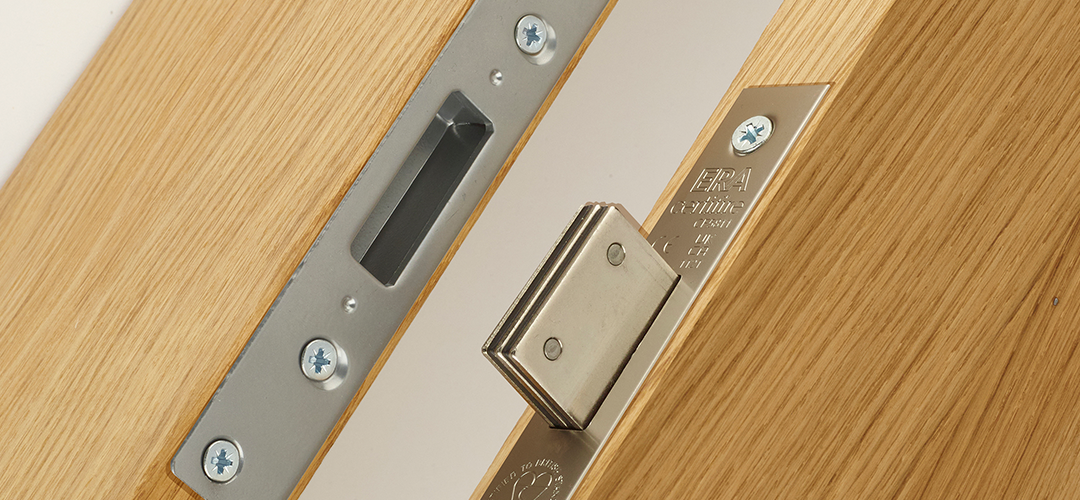
A mortice lock is a locking mechanism that sits inside the body of a door, housed within a pocket — called a mortice — cut into the door edge.
Unlike a surface-mounted rim lock, a mortice lock is concealed within the door itself, with only the forend (faceplate) visible once fitted.
This makes it both aesthetically clean and structurally more secure, as the lock case is protected by the surrounding door material.
Mortice locks are the primary security hardware for traditional timber entrance doors across the UK and remain the lock of choice for door set manufacturers, housebuilders, and installers working to meet UK building regulations.
Mortice lock types: deadlock vs sashlock
There are two fundamental types of mortice lock, and understanding the difference is essential for correct specification.
Mortice deadlock
A deadlock contains a single deadbolt, operated in both directions by a key. It provides no latch function — the door is held shut only when the bolt is thrown.
Deadlocks are typically used as a secondary lock on external doors, often in combination with a nightlatch above, or as a standalone lock on doors that do not require a handle.
Mortice sashlock
A sashlock combines a deadbolt and a spring latch within a single lock case. The latch engages automatically when the door closes, and a handle retracts it to open.
The deadbolt is thrown separately by key. Sashlocks are the standard choice for external doors that use lever handles, as the handle and lock operate from the same case.
As a general rule: if the door has handles, specify a sashlock. If it does not, specify a deadlock.
Lever counts explained: 2, 3 and 5-lever mortice locks
The number of levers inside a mortice lock is the single most important indicator of its security level.
Each lever must be lifted to the correct height by the key for the bolt to operate — more levers mean a more complex key profile and a harder lock to pick.
2-lever mortice locks
These offer basic security and are suitable only for internal doors such as cupboards or utility rooms. They should never be specified for external doors.
3-lever mortice locks
These provide a moderate level of security and are commonly used on internal doors where a degree of privacy or security is required — bedroom and bathroom doors, for example.
They are not suitable for external use where insurance compliance is required.
5-lever mortice locks
These are the standard for all UK external doors. A 5-lever lock is significantly harder to pick than a 2 or 3-lever equivalent and is the minimum lever count required to achieve BS 3621 certification.
For door set manufacturers and installers working on entrance doors, a 5-lever lock should be the default specification.
BS 3621 explained: what it means and why it matters
BS 3621 is the British Standard for thief-resistant lock assemblies.
It is published by the British Standards Institution (BSI) and sets out the performance requirements a mortice lock must meet to be classified as suitable for external doors from a security and insurance perspective.
To achieve BS 3621 certification, a mortice lock must pass rigorous testing across multiple attack methods including picking, drilling, and forcible entry.
A mortice lock must have at least 5 levers to conform to BS 3621 — a 3-lever mortice lock cannot be BS 3621 Kitemarked.
A BS 3621 lock will carry the BSI Kitemark on the lock case itself, which is the simplest way to verify compliance at the point of installation.
For door manufacturers, BS 3621 compliance is a core component of meeting Building Regulations Part Q for new-build dwellings.
For installers, it is the standard most UK home insurers require on external doors — and in many cases, policies will be invalidated if a non-compliant lock is fitted.
Most UK home insurance policies require a BS 3621 certified mortice lock on external doors, or an MPL equivalent. When in doubt, always specify a BS 3621 when using a mortice lock.
ERA's BS 3621 range: ERA's Fortress range includes both BS 3621:2007 deadlocks and sashlocks for external timber doors, Kitemarked and tested to the full British Standard.
Mortice lock dimensions: how to measure correctly
Getting the dimensions right is critical.
Fitting a mortice lock with the wrong backset or case depth is one of the most common — and costly — installation errors.
Think of measuring a mortice lock like measuring a new door frame: every millimetre matters, and an incorrect measurement means the lock either won't fit or won't function correctly.
The key measurements are as follows.
Backset
The backset is the distance from the centre of the keyhole (or spindle hole on a sashlock) to the edge of the forend.
Most backsets are commonly measured at either 44mm for a 64mm lock or 56mm for a 76mm lock.
Typically a lock adjacent to a glass panel will use the 44mm backset, and otherwise 56mm — but always measure to be sure.
Case depth
The case depth is the depth of the lock body, measured from the forend to the rear of the case. Standard case depth sizes are 64mm (2.5") and 76mm (3").
A 50mm case size is also available for doors with a narrow stile or aluminium doors.
Case height
The vertical measurement of the lock case from top to bottom. This determines whether the lock fits within the door stile without compromising structural integrity.
Forend length and width
The forend — or faceplate — is the visible strip of metal on the door edge once the lock is fitted. Faceplates may have a square or round end.
Forend dimensions must match the recess cut into the door edge.
Centres (sashlock only)
On a sashlock, centres refers to the vertical distance between the spindle hole and the centre of the keyway.
The ERA range has a standard centre dimension of 57mm. This measurement is critical for ensuring the correct handle set is specified alongside the lock.
|
Measurement |
Standard sizes |
Notes |
|
Backset |
44mm / 56mm |
44mm for glass-adjacent; 56mm standard |
|
Case depth |
64mm / 76mm |
50mm available for narrow stiles |
|
Bolt throw |
20mm minimum |
BS 3621 requirement |
|
Forend end |
Square or radius |
Must match door prep |
|
Centres |
57mm (ERA standard) |
Critical for handle specification |
Mortice lock materials and door compatibility
Mortice locks are primarily designed for timber doors, where the door material can be routed to accommodate the lock case.
However, correct specification also depends on the door type and application.
Timber entrance doors
The primary application for mortice locks. Both deadlocks and sashlocks are suitable. A 5-lever BS 3621 lock should be standard.
Composite doors
These typically use a multi-point locking system as the primary lock, but a mortice lock may be specified as a secondary or supplementary locking point. Always confirm compatibility with the door manufacturer.
Aluminium doors
A narrow-stile 50mm case depth mortice lock is available for certain aluminium door applications. ERA supplies aluminium-compatible door components separately.
Internal timber doors
2 or 3-lever mortice locks are appropriate for internal privacy and security applications. A 5-lever lock is unnecessary and disproportionate for interior use.
Keyless egress: what it is and when to specify it
Keyless egress is a variant of the mortice lock where the inside of the lock can be operated without a key — typically via a thumbturn.
This allows the occupant to exit the building quickly in an emergency without needing to locate a key.
Building Regulations require keyless egress on certain applications, particularly where a mortice lock is fitted to an escape route.
For manufacturers building door sets that will be used as fire escape routes or in residential properties subject to Building Regulations Part M (accessibility), keyless egress variants should be specified.
ERA stocks a dedicated keyless egress range within its mortice lock category.
Mortice locks and fire doors
For fire door applications, not all mortice locks are suitable.
Fire doors require hardware that has been independently tested and certified for use in a fire-rated assembly.
A suitable fire door mortice lock should be tested to BS EN 1634 and assessed for use on 30-minute and 60-minute timber fire doors.
Mortice lock vs multi-point lock: which to specify?
A common specification question for OEM manufacturers is whether to use a mortice lock or a multi-point locking system.
The answer depends primarily on the door type and the security standard being targeted.
A mortice lock engages a single bolt at one point in the door frame.
A multi-point lock engages at multiple points simultaneously — typically top, middle and bottom — distributing the locking force across the full height of the door.
Multi-point locking is standard on uPVC and many modern composite doors.
For timber entrance doors on new-build residential properties where PAS 24 compliance is required, a multi-point lock is typically the appropriate primary specification.
For timber doors in existing properties, replacement applications, or where a traditional lock cylinder is preferred, a 5-lever BS 3621 mortice lock remains the correct and compliant choice.
|
Mortice Lock |
Multi-Point Lock |
|
|
Primary door type |
Timber |
uPVC / Composite |
|
Security points |
Single |
Multiple |
|
BS 3621 applicable |
Yes |
No (PAS 24 applies) |
|
Installer complexity |
Lower |
Higher |
|
Replacement ease |
High |
Moderate |
Our mortice lock range
ERA's mortice lock range is designed for the full spectrum of doorset manufacturers and installer requirements, from standard 5-lever applications through to high-security British Standard and fire-rated variants.
The range includes: British Standard 5-lever deadlocks and sashlocks (Fortress range, BS 3621:2007 certified); standard 5-lever deadlocks and sashlocks for non-BS applications (Visocunt); keyless egress variants with thumbturn operation (Fortress range, BS 8621:2007 certified); rebate sets and spares for rebated door applications; and rim locks for surface-mounted applications.
All ERA mortice locks are available through the ERA Everywhere trade platform, with online ordering, account management, and next-day delivery on qualifying orders.
Want to find out more?
Browse our mortice lock range or apply for a trade account to access trade pricing, online ordering, and dedicated technical support.
Chat to one of our team today here.
